Showing posts with label Bill Nicholson. Show all posts

Friday, December 24, 2010

In Search of Alan Gilzean (a book by James Morgan)

Alan Gilzean signed for Spurs in mid-December, 1964 and made his debut in a home game against Everton. He scored his first goal for the club a week later on Boxing Day as Spurs achieved their first and only away win of the season at Nottingham Forest. Two days later he scored his first League goal at White Hart Lane when Spurs defeated Forest 4-0 in the return match. This was the game which saw me become a Spurs supporter and so following the team closely through the rest of the 1960s and early 70s, I am familiar with Gilzean’s successful career at White Hart Lane.


However, what of Gilzean before and after his Tottenham days? I knew that Gillie had signed from Dundee for a fee of £72,500 and that he had already played for Scotland before coming to Tottenham and that after retiring in 1974 he had played in South Africa before returning to manage a transport business and that his son, Ian, had been a young player at Tottenham. Beyond those few basic points very little was known of Alan Gilzean who while at the club was ‘The King of White Hart Lane’.


In the summer of 2005, into this vacuum came some internet rumours of Gilzean being down and out and living somewhere in the west of England but no-one knew for certain whether this was true or not but with the immediacy of the internet, rumours very quickly become fact. There was much disappointment and sadness among Spurs’ fans that one of their ‘legends’ who had brought such enjoyment and success to the club, could be living in hardship.

It was at this point that James Morgan, a sports journalist with the The Herald newspaper in Glasgow, set about trying to establish the truth of the matter. Morgan is a Spurs’ supporter and Alan Gilzean was his late father’s favourite player and he had frequently heard of Gilzean’s talent and contribution to Spurs’ success. His early research into Alan Gilzean yielded little, even Hunter Davies ‘The Glory Game’ shed little light on the subject, leading the author to feel that Gillie had become the forgotten man of both Scotland and Tottenham.


Morgan’s research has been extensive and he used his numerous contacts as a journalist to speak to former friends, colleagues and acquaintances of Gilzean in his endeavours to discover the truth. Everyone whom he spoke to regarded Gillie highly – in awe at his talent as a player and of his generosity as a person. His former colleagues recounted many stories of his playing days both north and south of the border and they regretted having lost touch with him and asked the author to pass on their best wishes to Alan if he managed to track him down.


Today, many sporting biographies detail the sensational lifestyle of a celebrity sportsman to shock the public and grab a striking headline for the newspaper serialisation. James Morgan has written this book about Alan Gilzean as a fitting tribute to the private man who displayed an exceptional talent as a player for Dundee, Tottenham Hotspur and Scotland.


‘In Search of Alan Gilzean’ covers his life from his youngest days in Coupar Angus in Scotland where he grew up and played football for the local team. It discovers the difficulties of combining National Service in the army with a developing football career. It details his successful career with Dundee when Gilzean was a vital member of the team that won the Scottish Championship in 1961- 62 and then was their star player as Dundee took European football by storm to reach the semi-final of the European Cup, only to lose in controversial circumstances, something all Spurs’ fans can relate to with their club’s experience against Benfica a year earlier.


Gilzean progressed to the Scotland team but suffered first with the selectors’ preference for players from the two Glasgow clubs while he was with Dundee and then their opposition to Anglo-Scots during his years at Tottenham. In total he made 22 appearances for his country and scored 12 goals but with a professional career spanning fifteen years in top flight football in Scotland and England, he surely deserved many more.


Gilzean arrived at Spurs following a protracted transfer saga as Bill Nicholson considered his suitability as the player to replace Bobby Smith. It was perhaps the two goals that Gillie scored for a Scotland XI at White Hart Lane in John White’s Memorial game that finally persuaded the manager to go ahead with the transfer. Gilzean immediately hit it off with his strike partner, Jimmy Greaves, who described him as ‘the greatest player I played with’.


Alan Gilzean was an adaptable player with an outstanding ability to head the ball both to score and to create chances for his team. He was a goal-scoring inside forward with Dundee but he played as centre forward for Spurs to support Greaves and when Martin Chivers arrived in 1967 he again adapted his style to play alongside the strong running centre forward. The arrival of Ralph Coates at Tottenham in 1971 suggested Gillie might be on his way out but he continued to be a part of the Tottenham team which won the UEFA Cup and a second League Cup to add to his earlier FA Cup success.


Gilzean seemed to improve with age and he grew in popularity among the fans as his partnership with Chivers and Martin Peters developed to such an extent that he was an important part of Spurs' creativity as his delicate headers created many goals for himself and his two colleagues.


His eventual departure from White Hart Lane in 1974 meant that Gilzean slipped off the football radar. Not for him, the corporate, hospitality work that many retired players have now become involved with. He moved out of football circles to retain his privacy and so became largely forgotten by all but a few ardent fans. Morgan discovered that many in Coupar Angus, his home town, had never heard of Alan Gilzean and the local council had done nothing to mark his contribution to Scottish football. The ‘forgotten man’ of Scottish football has only recently been inducted into both the Dundee and the Scottish Football Association’s Halls of Fame due to pressure from James Morgan who put Gilzean’s name forward as a worthy recipient for the award.


Many books have been written about Spurs since the 1950s and this book is a worthy addition to that collection and a fitting tribute to a Spurs great. Many players who have contributed much less to the Spurs' cause have had books written about them so it's good to have Gilzean's contribution marked in this way.


The author did a great job weaving the past detail of Gilzean's career with his search for the great man and his struggle to keep his emotions as a Spurs’ supporter in control was clearly evident as he met some of his past heroes for the first time so that his journalistic endeavours would be rewarded.


Many rumours and stories existed about Gilzean’s career and his life after football and Morgan has endeavoured to find answers for them and as one reads the book there is the constant temptation to turn to the final chapters to discover if the search was successful.


Why did Alan Gilzean so dislike Bob Wilson, the Arsenal goalkeeper? The comparisons with Dimitar Berbatov are considered. Did Morgan meet up with Gillie? Those are some of the issues and questions you will have to read the book to find out about.


While Alan Gilzean has spent the last thirty six years avoiding the spotlight in order to maintain his privacy, perhaps this excellent book by James Morgan will demonstrate to him how highly he is regarded by those colleagues whom he played with and by those supporters who sang his name every week from the terraces and that if he were to return to White Hart Lane he would receive a rapturous reception.


A place awaits Alan Gilzean in the Tottenham Hotspur Hall of Fame – a true legend of White Hart Lane.


Google


Wednesday, August 18, 2010

Tottenham Hotspur Champions League Qualifier

Tottenham Learn Lessons from the ‘Double’ Team


Harry Redknapp’s Tottenham Hotspur team 2010 did their utmost to emulate Bill Nicholson’s great ‘Double’ winning team in their first foray into European football’s top club competition for forty nine years. Unfortunately, it was not one of that team’s outstanding performances that they tried to copy but rather one of their poorer and most surprising defeats.


In season 1961-62 as reward for winning the 1st Division title for the second time in their history, Spurs took part in the European Cup, the fore-runner of today’s Champions League, which had been in existence for only six years and had been the preserve of Real Madrid who had won the first five competitions.


13th September, 1961

European Cup (1st Round 1st Leg)

Tottenham were drawn against Polish champions, Gornik Zabreze with the first leg away from home. In front of a hostile 90,000 crowd Nicholson played his full strength ‘Double’ winning team and to their horror they were three goals behind at half-time. In the opening seconds the home side hit the bar and then were gifted the lead after eight minutes following a defensive error leading to an own goal. Gornik attacked at will and Spurs made numerous errors and went further behind on twenty minutes. Mistakes continued and a third goal came just before half-time. Two minutes after the interval, having failed to learn from the earlier mistakes, Gornik were presented with their fourth goal. The hostility of the crowd increased with Tottenham’s robust tackling which saw their team reduced to ten men as one of their players wentoff injured.


Twenty minutes from time the Tottenham revival started with the battling Dave Mackay making a run and cross that enabled Cliff Jones to head a goal to reduce the arrears. Four minutes later Mackay created a second with a cross that Bobby Smith knocked down for Terry Dyson to score. With no substitutes in those days Gornik Zabreze were reduced to nine men when their young centre forward went off injured twelve minutes from time.


As Spurs left the pitch to booing and whistles, the Zabreze coach said that they had played many foreign teams but this Tottenham side was the hardest he had ever known. However, Bill Nicholson was confident Spurs would overhaul the Zabreze miners in the second leg at White Hart Lane. Desmond Hackett in his match report for the Daily Express wrote: ‘This was Super Spurs reduced from champs to chumps in ninety uneasy minutes.’


Team: Brown; Baker, Henry: Blanchflower (Capt), Norman, Mackay; Jones, White, Smith, Allen, Dyson.


17th August, 2010

Champions League (4th Qualifying Round 1st Leg)

After waiting so long this was Spurs’ opportunity to make a positive start towards the new world of the Champions League group stages. But what a start – inside four minutes Tottenham had seen Young Boys of Berne hit the post with Heurelho Gomes beaten, had Benoit Assou-Ekotto booked for tripping and conceded a goal which encouraged the Swiss team and their vociferous supporters to even greater efforts. Unable to settle on the artificial surface the Spurs players were tentative in their passing, unsure of their movement and looking in some disarray. This increased after thirteen minutes when a defensive error from Michael Dawson allowed the Berne striker through on goal to finish coolly past Gomes. After half-an-hour Spurs were three down when the defence was caught out by a through ball and Gomes had no chance. This was not in the script as perceived by the Spurs faithful many of whom had anticipated a safe passage past the ‘no-hopers’ from Switzerland. However, it was very much in line with the copycat performance of events in Poland forty nine years earlier.


Harry Redknapp introduced Tom Huddlestone before the interval and this brought an element of control to the Spurs play and for the first time in the game they weren’t chasing around hopelessly but started to exert some pressure in the match which resulted in a number of corners ahead of the break and from one of them Sebastien Bassong atoned for this defensive short-comings by heading the first Spurs goal.


The second half showed Spurs with more control but despite early possession they were unable to add to their goal tally. The Swiss continued to be dangerous on the break and could have increased their lead but this time, fortunately for Tottenham, they were not as clinical in their finishing. Then with seven minutes remaining Roman Pavlyuchenko who had experience of playing on a similar artificial surface with his former club but had had a very poor evening in Berne, received a pass from Robbie Keane and hammered an unstoppable shot inside the goalkeeper’s near post. Now, only a goal down Spurs settled for what Harry Redknapp described as a ‘great defeat’.


Team: Gomes; Corluka, Dawson (Capt), Bassong, Assou-Ekotto (Huddlestone); Dos Santos, Palacios, Modric (Kranjcar), Bale: Defoe (Keane), Pavlyuchenko.


Lessons Learned

In 1961 against Zabreze Bill Nicholson was unable to make any immediate change in personnel as no substitutes were permitted but he realised that for the away European Cup games he couldn’t afford to play the same style of football that had brought the ‘Double’ team such success in domestic competitions. In future away ties he introduced Tony Marchi as an extra defensive security. He had played football in Italy and his experience played a vital role in Spurs future progress.


Harry Redknapp was fortunate that with a bench of experienced players he had the opportunity to try to correct the failings identified early in the game against Young Boys. Huddlestone contributed greatly to the control that Spurs took of the game after his introduction and the other changes saw the manager work with a narrower midfield rather that the more extravagant wide players of Giovani Dos Santos and Gareth Bale. With Luka Modric and then Nico Kranjcar on the left of midfield they came inside much more and allowed Bale to attack from defence.


The Outcome

In 1961 the return leg introduced the football world to one to the first of those great ‘Gory, Glory European Nights’ at White Hart Lane. In an electric atmosphere, Spurs hit the bar inside thirty seconds and took the lead on nine minutes with a Danny Blanchflower penalty. Cliff Jones terrorised the Gornik defence and scored a first half hat-trick in seventeen minutes but the visitors also managed to grab a goal to keep their hopes alive. Before half-time Bobby Smith scored and Spurs were 7-5 ahead on aggregate. In the second half Smith added his second, Terry Dyson scored number seven and John White completed the scoring with a minute remaining to make the score 8-1 for Tottenham.


Having followed the 1961 script so closely for the away match, it is to be hoped that Tottenham 2010 will get their lines right in a similar fashion next week to ensure the club make it into the lucrative group stages of the UEFA Champions League and that the fans don’t have to wait another forty nine years to experience competition at the highest level in European football.


Google


Friday, August 13, 2010

Spurs' Goals for the New Season

Another summer anticipating new signings at White Hart Lane draws to a close with nothing to show, as yet, but expectations for the new season remain high. It will be difficult to maintain the level of consistency shown throughout the greater part of last year when European games are added to the fixture list but that’s what Tottenham have been striving for over the past number of years. It’s fitting that Tottenham embark on their first season in the Champions League in the year that marks the fiftieth anniversary of Spurs’ greatest ever year and team – the 1960-61 ‘Double’ side. The team that earned Spurs a place in the European Cup and did so much to emblazon the name of Tottenham Hotspur across Europe and worldwide.


As the legendary Bill Nicholson said, “It's magnificent to be in Europe and this club - a club like Tottenham Hotspur - if we're not in Europe, we're nothing.”


Once again Spurs have that chance in Europe’s top competition and the opening matches of the season will go a long way to define the success or failure of the season that lies ahead. Failure and we could repeat the Everton scenario of their Champions League year, while success opens up bold, new horizons. There are the crucial qualifying games against Young Boys Berne to reach the group stages of the Champions League and three vital Premier League games before the end of August. Last year Spurs took nine points from the corresponding fixtures and to maintain a position in the top four that level of consistency is going to be vital. To fail in these games could really dampen the spirit of optimism surrounding the club and spectators as the season opens.


To date, transfer activity for Spurs has been limited to rumours of possible targets and probable departures. Presumably, the Chairman will be activating his usual ‘last-minute.com’ policy once he is aware of Spurs European status in the last week of August – Champions League or Europa League.


Spurs immediate goal for the season must be to reach the group stages of the Champions League with a long term objective of building on last season’s progress by maintaining their top four position. However, that will not be an easy task with Manchester City signing players for fun and lavishing excessive salaries upon them while Liverpool are determined to revitalise their flagging fortunes under Roy Hodgson and are fortunate to have retained their star players. If Spurs are unable to achieve these short and long-term targets Daniel Levy may regret his unwillingness to speculate in order to strengthen the team this summer.


There is much to look forward to this season and there is a great buzz of expectation around the club at this moment in time. Spurs are in their strongest position for many years and it is to be hoped that they will progress to an even higher level and by next May will have some silverware to show for all their efforts.


50 Years Ago today - Saturday, 13th August,1960


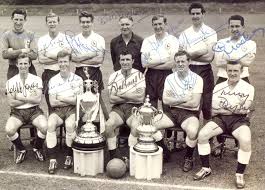
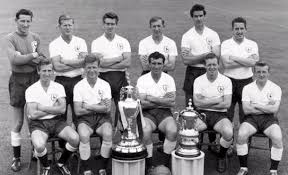
Spurs 'Double' winning team - 1960
It was 50 years ago today that Spurs supporters had the first glimpse of the greatest team in the club's history which was about to embark on a season that would never be forgotten and would set the standards for every other Tottenham Hotspur team, standards which, to date, none have ever reached.
 
On the second Saturday of August the Public Trial Match was played at White Hart Lane.  In those days there were no pre-season tours or friendly matches played, the final preparation was the annual match between the 'Whites' (1st Team) and the 'Blues' (Reserves) and the public had their first opportunity to see the team ahead of the new season.  There were no new players on view and the first team only showed one change from the team which had finished the previous year - Les Allen replacing Tony Marchi. The matches were always very competitive as players tried to catch the manager's eye with an impressive performance that would ensure their place in the team for the first League game to be played the following Saturday at 3.00pm.
 
Reporting on the game in the match programme for the Everton game it was noted that the players had completed three weeks training at Cheshunt and 11,677 spectators were present to see a 4-4 draw with all the proceeds donated to charity. 
 
The match was evenly contested but midway through the second half the 'Whites' had taken a 4-1 lead and looked to be on their way to a comfortable win.  The 'Whites' went ahead from a Cliff Jones penalty half way through the first half and this was followed a few minutes later by a goal from Dave Mackay who having 'joined in a left-wing attack and from almost the bye-line lashed a fierce drive just inside the near post' - one of the highlights of the afternoon.
 
Early in the second half Terry Dyson scored the third after a shot from Les Allen hit the bar.  Immediately, the 'Blues' pulled a goal back when Terry Medwin scored from Frank Saul's cross with a flying header.  Immediately, Les Allen restored the three goal margin.
 
The 'Blues' staged a late comeback as Jimmy Collins and Frank Saul scored to reduce the arrears and then Collins added his second in the final minutes following a defensive mix-up.
 
Bill Nicholson obviously knew his best team as the 'Whites' team was composed of all the players who are most closely associated with the 'Double' team and who were to appear in the final 'Double' clinching match at Wembley the following May.
 
'Whites': Brown; Baker, Henry; Blanchflower, Norman, Mackay; Jones, White, Smith (R), Allen, Dyson.
 
'Blues': Hollowbread, Hills, Hopkins; Smith (J), Ryden, Marchi; Medwin, Harmer, Saul, Collins, Aitchison.


Google


Thursday, August 12, 2010

Spurs' Summer Expectations Shattered Once Again.


Ardiles - World Cup Winner


The early summer expectations of a World Cup that would throw up a host of foreign players who would enhance the Premier League were quickly dashed as the realisation dawned very early in the competition that South Africa 2010 was a rather poor and disappointing vintage to offer to the world.  Tottenham Hotspur have benefitted in the past from World Cup signings - they set high standards when Keith Burkinshaw returned to Argentina to sign World Cup winners, Ossie Ardiles and Ricky Villa.  In 1984 Alan Sugar pulled a rabbit out of the hat with the unexpected signing of Germany's Jurgen Klinsmann but on other occasions the stars of the World Cup have disappointed when faced with the rigours of English football.  This year there were few who did themselves much good in the shop window of the World Cup.


Every summer Spurs fans hope for an early resolution to all transfer negotiations as the manager, with the Chairman's assistance, endeavours to strengthen the Tottenham team for the following season.  The reasoning being that on the resumption of training all the new players will be in place and the work of preparing for the new season can commence in earnest.  However, sadly, once again, this has proved to be a forlorn and false hope as, to date, no new signings have appeared at White Hart Lane.  The only signing of note has been the acquisition of the young Brazilian midfield player, Sandro, but he remains in his homeland and is not expected to be available until September. 

The rumour mill has once again been in full swing with Spurs centre field for every conceivable target but no-one has signed on the dotted line and held up the lilywhite shirt at White Hart Lane.


For many years as Spurs have chased possible transfer targets, the lack of first, European football, and then Champions League football has always been held up as a reason why players have been reluctant to commit themselves to Spurs.  But now with Champions League football beckoning, players still show a reluctance to come to Tottenham.  In past years all we could do was watch as our star players went off to pastures new to fulfill their dreams of playing for the top clubs in the top competitions - Sol Campbell deserted Tottenham for our closest rivals, Arsenal, Teddy Sheringham, Michael Carrick and Dimitar Berbatov couldn't wait to get to Old Trafford while Robbie Keane had to sign for his boyhood team, Liverpool.  Spurs couldn't offer those players the opportunity to play at the highest level so there was nothing the club could do but release them with their best wishes and accept the transfer fees to swell the coffers while we, the fans, felt betrayed and disconsolate.  However, now things have changed, Spurs have access to the Champions League while Liverpool are consigned to the Europa League, that should make a difference.  But No - Spurs are still struggling to make those important signings while Liverpool have managed to hold on to their stars - Steven Gerrard and Fernando Torres and have persuaded Joe Cole to move north to Anfield rather than move to Tottenham.  So as Manchester City and Liverpool have proved, players aren't just interested in the playing opportunities, they're very interested in the money on offer and will go to wherever they get the best salary.  Perhaps, Mr Levy will have to reconsider his financial restrictions where transfer fees and salaries are concerned if Tottenham Hotspur are going to become one of the big players in the Premier League as well as in Europe.  No-one wants Spurs to spend foolishly or offer extravagant salaries but to achieve greatness there will have to be a loosening of the purse strings to attract quality players to the club.


With less than three weeks remaining of this very quiet transfer window, it is to be hoped that any signings will improve the quality of the team and not just be a signing for the sake of it - in the past Spurs have suffered through Mr Levy's desire to shop at 'last-minute.com'.  Late, hasty purchases rarely achieve great success.  Spurs need better than that if they are to maintain the progress achieved by Harry Redknapp in the past two years.


Google